Skip to content
Copperleaf Air Duct CareAir Duct Care LET’S TALK(669) 345-4827
Menu

Burbank

Conditions

Chemical Treatment Review in Burbank

A provider proposes a biocide, ozone, or sealant inside ductwork.

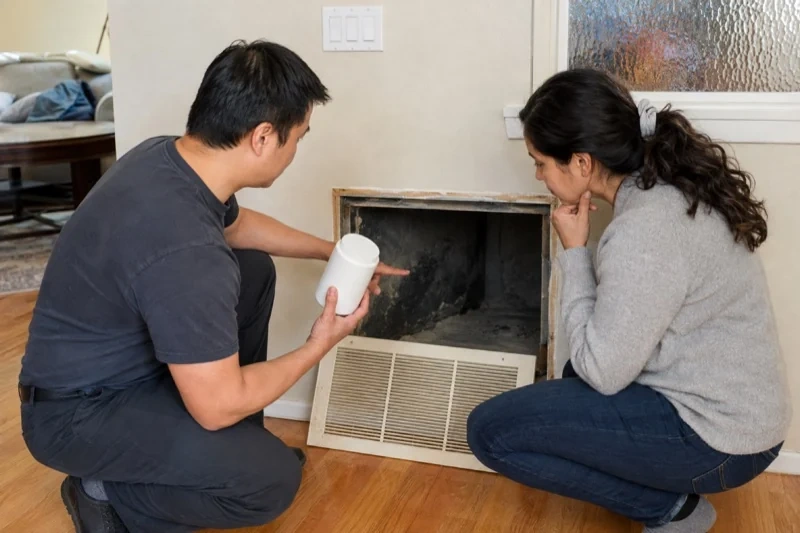
Two people crouching beside an open wall return, one holding a white cylindrical container and pointing inside.Service illustration · not a completed customer project

THE WORK, EXPLAINED

Start with the condition.
Understand the scope.

Ask which product, purpose, label-authorized use and system material are involved before considering a proposed chemical treatment. EPA does not recommend routine sealant use and identifies unresolved questions about these treatments. Request an explanation of alternatives, prerequisites and limitations from the responsible professional; this service guide is not product approval.

What may be involved

  • product label
  • duct material
  • documented condition
  • written justification

Ask the provider to distinguish existing parts to inspect, proposed replacements, and tools, materials or reports included in the service. Confirm the work and exclusions after assessment; this list does not mean that every item will be supplied or replaced.

LOCAL RESEARCH / Burbank

Local context

The US Environmental Protection Agency does not recommend that air ducts be cleaned routinely, but only as needed, and lists the conditions that would justify it: substantial visible mould inside hard-surface ducts or system components, ducts infested with vermin such as rodents or insects, and ducts clogged with excessive dust and debris that is released into the home. EPA also says no chemical biocides are currently registered for use in internally insulated air duct systems, and that sealants are not recommended for routine use. Ask to be shown the condition before agreeing to a scope. EPA guidance describes when cleaning may be appropriate; it is not a diagnosis of your system.

Source ↗

Area-wide context does not establish the condition of your property or equipment.

Before the visit

Building age and weather cannot establish duct contamination. The system itself needs to be inspected.
Related components & services.

A LITTLE CLARITY

Good questions.
Straight answers.

What does chemical treatment review involve?

Ask which product, purpose, label-authorized use and system material are involved before considering a proposed chemical treatment. EPA does not recommend routine sealant use and identifies unresolved questions about these treatments. Request an explanation of alternatives, prerequisites and limitations from the responsible professional; this service guide is not product approval.

How is the price decided?

The scope depends on the condition, access and parts needed. Ask for a written quote for chemical treatment review, including any callout charge, before authorizing work. Prices are not published on these pages; ask for the written quote.

What information should I have ready?

Describe the issue: A provider proposes a biocide, ozone, or sealant inside ductwork. Have your address, relevant model or hardware details and any previous work records ready.

How soon can the work be arranged?

Confirm availability and the expected time on site when you contact the provider. Access, diagnosis and parts availability can affect the appointment; this page does not promise an arrival time.

How will I know what is included?

Ask which of these are part of the proposed scope: product label, duct material, documented condition, written justification. Confirm exclusions and the completion check in writing.

Is coating the inside of a duct the same as sealing an air leak?

EPA distinguishes encapsulating an internal surface from sealing duct air leaks. Ask which purpose is proposed and where the product would go, so these different scopes are not combined under a vague sealing description.

Can a coating simply cover wet lining, growing mold or debris?

EPA says sealants should not cover those conditions. Ask the provider to document the condition and explain the prerequisite work and alternatives; a coating proposal is not evidence that contamination or moisture has been addressed.

Does an ozone treatment establish that indoor air is clean?

No. EPA reports that ozone is generally ineffective for indoor pollution control at concentrations within public-health standards, and that ozone can harm health. Do not treat an ozone odor or treatment claim as evidence of successful cleaning.

Does following an ozone generator manual guarantee a safe exposure?

EPA reports that some generators can exceed health standards even when operated according to their instructions. Request qualified advice about the proposed approach and alternatives; this service guide does not approve equipment, exposure conditions or re-entry.

References for these answers

EPA: duct treatments and sealants ↗

EPA: ozone generators and limitations ↗

Burbank

Start with your address.

Find the service you need, then confirm the work and availability for your property.

Related work.

Explore the service that matches the issue.

This service, near you.

EXPLORE THE PHOTOGRAPHS

Photo gallery

YOUR NEXT STEP

Less guesswork.
A clearer next step.

(669) 345-4827

Tell us what’s happening.
Confirm scope and availability when you call.

Call (669) 345-4827

LET’S UNDERSTAND THE JOB

What can we
help with?

This form prepares a summary in your browser to read out on the call. It does not send a request.

Copperleaf Air Duct CareBurbank(669) 345-4827